 Browsing History
Browsing History captures every visited URL on Windows and Mac, time spent per page, and search queries — across Chrome, Edge, Firefox, Safari, Brave, Opera, and Tor — and works in private or incognito mode where the browser keeps no record of its own. Built into Refog Personal Monitor and Employee Monitor. Start a free trial.
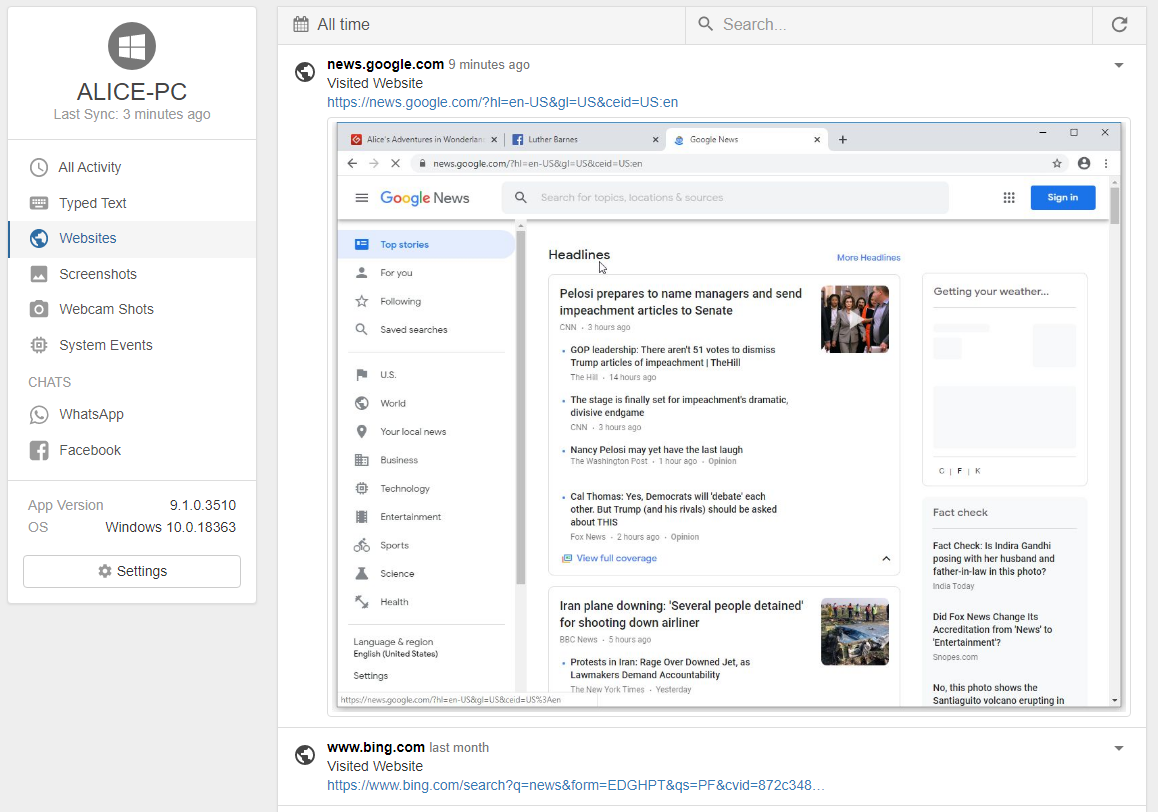
Browsing history monitoring goes well beyond the History tab a browser keeps on its own. The native history is easy to clear, automatically wiped in private or incognito mode, and unique to each installed browser — a child can switch to a less-watched browser, use private windows, or delete the trail in five seconds. Refog logs visits at the operating-system layer as the page loads, so the record is preserved no matter which browser is in use, regardless of incognito mode, and even after your child or disclosed employee clears their history. The captured timeline includes the URL, page title, search query (when one is part of the URL), the time the page became active, and how long it stayed in the foreground.
Modern browsers also store a great deal of context — referrer pages, click-through transitions, autocomplete trails, and per-site time accounting — that disappears the moment the History tab is cleared. Refog reconstructs that context independently. Used together with application monitoring and user activity tracking, the browsing timeline answers not just which sites were opened but what your child or disclosed employee was doing on the computer at the same moment.
How browsing-history monitoring works
Refog observes URL events at the system level rather than reading the browser's local history database. As soon as a page is loaded, the URL, title, and timestamp are written to an encrypted local log together with the account that triggered the navigation. A separate active-tab monitor records how long each tab stayed in the foreground, distinguishing a quick redirect from a long reading session. Search queries embedded in URL parameters (Google, Bing, DuckDuckGo, YouTube, Amazon) are extracted and indexed separately, so a parent or auditor can search the history by query term, not just by domain.
Use Refog to:
- Log every URL visited across Chrome, Edge, Firefox, Safari, Brave, Opera, Vivaldi, and Tor — independent of the browser's own history setting.
- Capture private and incognito sessions — Refog records at the system level, so private-browsing mode does not hide the visit from the report.
- Index search queries separately — see what was searched on Google, Bing, YouTube, Amazon, or any other search-driven site, and filter the timeline by keyword.
- Measure time on page — distinguish a five-second redirect from a 40-minute reading or video-watching session.
- Categorize sites automatically — social, gaming, video, adult, and shopping categories are flagged so a long timeline becomes scannable.
- Reconstruct browsing trails — see which page led to which through referrer and transition data, useful when understanding how your child or disclosed employee arrived at a problematic destination.
Common use cases
Parents — protection from grooming and predatory contact. Online predators often start in public spaces — chat rooms, gaming communities, comment sections — before moving to private messaging. Refog's browsing-history record, combined with chat tracking, preserves the early conversations that lead to a private hand-off, giving parents the chance to spot the pattern early. Pair it with parental monitoring software for a more complete view of online behavior.
Schools and educators — content-filter audit. A content filter is only as good as its audit trail. Refog provides the independent record schools need to verify that filters are working, that bypass attempts are visible, and that actual student browsing patterns match the policy on paper. The export-to-CSV workflow fits the reporting requirements most district IT teams already work with.
Self — productivity and focus self-audit. A growing audience of professionals deploy monitoring on their own computers, voluntarily, to understand where their focus actually goes during the workday. Refog produces an honest browsing timeline that no amount of self-reporting can match — a useful tool for anyone running an experiment to reduce social-media drift or improve deep-work hours.
What you'll see in reports
The browsing-history report groups visits by user, day, and category, with each entry showing the URL, page title, time of visit, total time spent on the page, and the originating browser. A separate search-query view lists every term searched across major engines, ranked by frequency. Category summaries highlight time spent in social, video, gaming, shopping, and adult categories so the day's pattern is visible at a glance. From any history row you can jump to the matching screenshot or session-timeline entry for full context.
Privacy and legal note
Refog is designed for monitoring computers you own or for which you have a clear lawful basis to monitor — your own family devices or company-owned endpoints with a written, disclosed acceptable-use policy.
"Browsing-history monitoring is most defensible when it is paired with disclosure and a clear, narrowly drawn purpose — open communication is the single biggest predictor of whether a deployment holds up in a dispute." — Refog deployment guide for HR and IT teams
Always check the laws and regulations in your country, state, and industry before deploying browsing-history monitoring software, especially in regulated industries with strict employee-consent rules.

