 Screen Capture
Screen Capture takes periodic screenshots of the full desktop and the active window on Windows and Mac, with optional webcam snapshots — providing visual evidence beyond what any text-only log can show. Designed for parents who need to see what a chat was actually about and for employers who need workflow context behind keystroke and application logs. Built into Refog Personal Monitor and Employee Monitor. Start a free trial.
Screen capture monitoring answers the questions text logs leave open. Who was on the other end of that chat? What did the recipient actually reply? Which app does the captured password belong to? Keystrokes alone show only what the user typed — they say nothing about what the user saw, who they were talking with, or what was on the rest of the screen at the same moment. Periodic screenshots fill that gap.
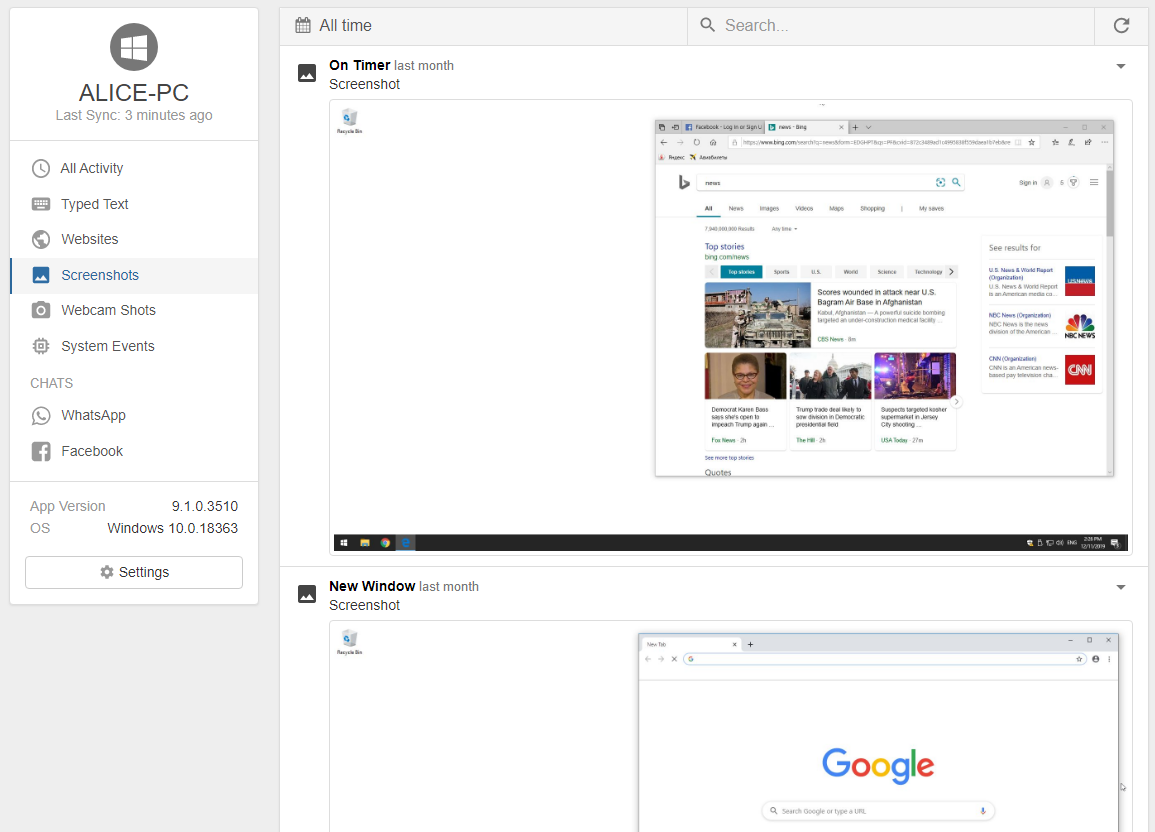
A single screenshot shows every running app, every open window, the foreground app, the contact in the chat panel, and any document or image on screen. Combined with application monitoring, user activity timelines, and the browsing history record, screen capture turns a fragmented text log into a complete visual story.
How screen capture works
Refog takes screenshots on a schedule you control — commonly one per minute during active sessions, or triggered by specific events: a chat window opening, a new application launching, a USB drive connecting, a keyword from a watchlist being typed. Captures are stored in an encrypted local cache and uploaded to your Refog dashboard. Each screenshot is tagged with the user, active window title, foreground app, and timestamp, so finding the visual context for any text-log entry takes seconds.
For deployments that need extra evidence, optional webcam snapshots take a short photo through the laptop or external webcam at the moment of capture — useful for confirming who is actually at a shared family computer, or for documenting that a specific user was present during a flagged event.
Use Refog to:
- Take periodic desktop screenshots — full screen or active-window only, at intervals from one minute up to once per hour, on a schedule you set per user.
- Capture webcam snapshots — front-camera photos taken at the same moment as the screenshot, to confirm who is at the computer.
- Trigger event-based captures — extra screenshots when a chat window opens, a USB drive is connected, or a keyword from your watchlist is typed.
- See the context behind every keystroke log — pair a cryptic typed string with the screenshot taken in the same minute to understand what app and what field it belonged to.
- Document chat conversations visually — including emoji, stickers, and quoted media that text-only loggers cannot reconstruct.
- Generate visual evidence for HR or forensic review — exportable image reels with timestamps and user attribution preserved for audit purposes.
Common use cases
Parents — visual evidence of risky chats. Text-only logs miss the most important parts of a conversation that worries a parent: the contact's profile photo, the friendly emoji that softens a manipulative request, the link preview to a sketchy site, the shared image. Screen capture preserves the full visible thread so a parent can see the conversation the way the child saw it, rather than reading a stripped-down transcript. Pair with chat tracking for a comprehensive view.
Employer — workflow QA and training. Managers and team leads use screen capture to understand how a workflow actually plays out — where users get stuck, which steps take the longest, which tools they switch between. The same captures double as training material, because a recorded sequence of "this is how the senior person does it" is more valuable than written documentation. Used transparently and with consent, it shifts from monitoring into coaching.
Trainers and operations — workflow review. Operations teams running customer-support or back-office workflows use screen capture to spot the gap between the documented process and what actually happens — steps that need automation, fields filled wrong repeatedly, and bottlenecks that show up as long pauses on the same screen.
What you'll see in reports
The screen-capture report presents a thumbnail timeline of all captures grouped by user and date, with each thumbnail tagged by the active window title and the capture trigger (scheduled, event, keyword). Click any thumbnail for full-resolution view, with arrow-key navigation through the rest of the day's captures. A separate panel lists event-triggered captures so unusual moments — first-time-launched applications, USB connections, watchlist keywords — surface without scrolling through every routine screenshot. Webcam snapshots appear in their own panel, paired with the desktop screenshot taken in the same moment.
Privacy and legal note
Refog is intended for monitoring computers you own or for which you have a clear, lawful basis to monitor — your own family devices or company-owned endpoints with a written, disclosed acceptable-use policy.
"Screen capture is the most visually invasive monitoring category — its deployment should always be paired with the strongest disclosure, the narrowest retention window the use case allows, and a clearly defined business or safety justification." — Refog deployment guide for HR and IT teams
Always check the laws in your country, state, and industry before deploying screen-capture monitoring software, especially in jurisdictions with strict employee-consent or visual-privacy rules.

